Hackney Photographs 1985 -1987 by Berris Conolly, Dewi Lewis Publishing 2014
A Journey Through Ruins by Patrick Wright, Flamingo 1992
Berris Conolly takes landscape photographs of the streets and parks, occupied and deserted, tended and neglected. He shows incongruity and awkward juxtapositions, but mainly dispassionate pictures of everyday urban scenes. They are beautifully composed pictures, informed by the picturesque, evoking a familiar awfulness; the beauty of the image often emerging from ugliness and mediocrity.
These are carefully chosen, immaculately crafted ordinary places in 1980s Hackney, which show a damaged city amongst verdant parkland. The studied detachment of the photographer echoes the approach of the American New Topographics movement and the beautiful composition and drear poetic qualities evoke the British photographer Raymond Moore. These urban landscapes are highly matter-of-fact: cars, brick walls, signs, shopfronts, railway arches, park paths, benches; and very complex: they show water, rail, parkland, education and housing, all reflecting an economic state of the time.
The book says ‘Berris Conolly photographed the places he knew…. There was no conscious or formal theme to the project, other than to record mainly the streets and buildings rather than people.’ Yet the book shows us real places, with street and park names, but tells us nothing more about the content of the photographs or the neighbourhoods they show. There is a hopelessly illegible map, the pictures are not ordered geographically, making orientation difficult. The brief notes at the end are inconsequential anecdote, or about what happened in later years. Consequently, Conolly’s 30 year old photographs are now more in danger of simply being nostalgic, the bane of all old photos and certainly not what the photographer intended for his complex urban scenes. Is the art of the photographer compromised by addressing the prosaic subject matter? if the locations, political decisions and dereliction is explained?
The book was published in 2014 by Dewi Lewis Publishing. Why publish photographs taken thirty years ago? The introduction to the book says, ‘This was a decade of turmoil in both national and local politics with issues of social justice never far from the headlines.’ Why publish without some explanation of the urban conditions, the policies, the politics that made these places? That would help make the inevitable comparison to now more interesting.
I am tantalised by the missed opportunity of a fruitful, complementary collaboration with the acclaimed Hackney Building Exploratory – a unique urban education centre engaging with residents of the borough, where informed insights on these pictures would have been enriching.
The prosaic urban content – the locations, the adjacencies, the land uses ask for a better appreciation of the landscape. This can be done without threat to Conolly’s distinctive visual poetry. This is where Patrick Wright makes an interesting companion.
Patrick Wright observing Hackney in the 1980s
Berris Conolly and Patrick Wright were both living in, and observing Hackney in the mid 1980s, Conolly through black and white photographs, Wright in his social and cultural commentary A Journey Through Ruins – A Keyhole Portrait of British Postwar Life and Culture – published by Flamingo 1992.
A combined reading of these two books is a powerful way of understanding Hackney as a place, in the context of the mid 1980s. Both give a telling message about the urban condition of Hackney.
Conolly’s pictures are full of the present moment – the living and working neighbourhoods of Hackney. These are pieces of Hackney, sometimes very small, but all absolutely part of a larger whole – a street or a neighbourhood. They are entirely about the current condition of the city – the same condition that Patrick Wright’s book articulates.
Of course, those who know Hackney know how parts of it have changed. In 2016 Hackney is topical, after the Olympics, after the hipster transformation of Shoreditch and Dalston, after the creeping gentrification of the artists’ quarters. We cannot look at these pictures without comparing to the present. But that is not the only point, these are all pictures of now. That’s what photographs are. These pictures are of a different now – a part of the inner city outside of desirable London, in the mid 1980s, in economic limbo, with an urban identity crisis, without investment. This is Thatcher’s London – shunned by government, high unemployment, the GLC abolished, no London strategy, left-wing councils and nuclear-free zones.
Conolly and Wright are describing a place at the nadir of urbanism. The pictures and narratives are the antithesis of the optimistic nineteenth century public works commissions and handsome housing developments that shaped the streets and parks. The pictures show a damaged town, tawdry businesses, a lack of maintenance of public places and hardly any new investment.

Berris Conolly – Broadway Market 1985
‘The graffiti may insist that the unimaginably blighted Broadway market is ‘not a sinking ship but a submarine’, but the people who make television crime shows recognise it as one of the choicest derelict streets in London. After filming the first two episodes of the BBC’s Paradise Club here, the producer declared Broadway Market to be ‘one of the last remaining sites in London with character.’ Patrick Wright A Journey Through Ruins 1992
Our practical and emotional attachment to places usually makes us oblivious to detail, our knowledge of our home and pathways to shops and park is coherent. These pictures fix and intensify the familiar and reveal the wear and tear. But how can we enjoy beautiful pictures of drab, unsightly places, of mud, dereliction, dented bumpers and overturned street lights? If they are documenting a story, what is that story? What is this place?

Berris Conolly – Dalston Lane 1987
‘This promiscuous exchange between idea and reality takes a different form on Dalston Lane, where images are brought in by advertisers rather than sought out by television producers…. The law governing the appearance of Dalston Lane stipulates that the more blighted and derelict an area becomes, the fuller it will be with vivid, if not always fashionably designed, imagery. Every derelict site is quickly surrounded by hoardings and the blaze of colour begins.’ Patrick Wright A Journey Through Ruins 1992
The photographs shows a Hackney that is rich with green space, and water, and 19th century terraces, against a backdrop of tower blocks and a fragmented spirit of place. The office boom is taking off in the adjoining City of London, a million miles away.
There is little new development evident in these pictures, the Council housing tower blocks were twenty years wise after-the-event and streets and public gardens had poor public maintenance. Central Dalston was blighted by the closed Dalson Junction railway station, the subject of complex planning and transport studies.
Wright’s book uses the ‘undemolished Dalston Lane’ and other streets and buildings to reflect on the wider implications of place and social change.

Berris Conolly – Dalston Junction 1987
‘What is to be done about Dalston Junction? Successive governments have pondered this question. Their advisers take one look and quickly propose a road widening scheme or, better still, a really ambitious new motorway that will obliterate the whole area. Ministers pretend to be surprised when carping residents come out against these generously offered ‘improvements’ and the blight settles a little deeper. In the most recent case it was Peter Bottomley, then Conservative minister for roads, who provided local campaigners with their best quotation. When questioned in the House of Commons on 10 February 1989 about the environmental damage that would be caused if the roads suggested in Ove Arup and Partners East London Assessment Study were built, he replied for the government by saying: ‘We want to improve the environment. If we look at the main spine road through the assessment study it goes through the most run-down part of the area.’ Dalston Junction was under that spine….. The south side of Dalston Lane starts with an elegant stretch of ornamented Victorian brickwork, which is all that remains of the recently demolished Dalston Junction railway station.’ ‘Patrick Wright A Journey Through Ruins 1992

Berris Conolly – Brownswood Road, 1985
‘Just the other side of Dalston Junction a notice informs all-comers that they are entering the London borough of Hackney’s declared ‘Nuclear Free Zone’…. left over from the early Eighties when Labour councillors were more interested in passing grandiose resolutions than in getting the basic administrative systems to work or, for that matter, even drawing up a budget for their revolutionary proposals.’
‘Since the Crichel Down inquiry, the onslaught has been directed against the whole conception of planning and State intervention that lay at the heart of the post war settlement. In recent years however the easiest targets of all have been found in the inner cities, where Labour councils have drawn far more obloquy than was invited even by the ‘loony left’ antics of Liverpool, Brent and sometimes Hackney itself. The extent to which the inner city areas have been damaged by this onslaught has been recognised by the Audit Commission, which in 1989 suggested the government’s unceasing rhetorical assaults on Labour local authorities were preventing the realisation of the government’s own plans for urban regeneration.’ Patrick Wright A Journey Through Ruins 1992

‘There is a public park in the borough known as London Fields. It is a place of modest attractions: some fine old plane trees, a new community centre, an open-air lido that, were it not for local objectors, the council would have already demolished….. Trains rattle by overhead. London Fields borders on the Cambridge line, and it’s not a bad spot from which to observe passing academics….. London Fields certainly has its dismal aspect. There have been some vicious assaults. Huge and unattended dogs run free. Young children from the nearby travellers’ site invade the infants playground… London Fields also clings to an understated respectability. On most days of the year, it is an uneventful and slightly melancholy place… if it has a message for the world… it merely points out that people can be poor without always being beastly. The park remains uncelebrated, but its name is too good to be true.’ Patrick Wright A Journey Through Ruins 1992
The condition of place
If we take Conolly’s pictures at face value, without much knowledge of the place, what do we see about the condition of the city?

Berris Connolly – Stonebridge Gardens, 1987
Housing – throughout the book, in many of these pictures, we see the threshold or collision of two different urban conditions – surviving Victorian Hackney streets – robust, shabby grandeur, with a backdrop of imposing yet remote residential tower blocks. The book seems to show two collided cities – the modernist city trying to coexist with the streets of terraces and Victorian recreation grounds. Tower blocks occur in many of the pictures, but always as background. There are few photographs within the estates, and hardly any sign of the new housing that was being built in the 1980s. The notes at the end say that nearly all these tower blocks have been demolished.

Berris Connolly – Pearson Street 1987. The imposing school building has very small playground areas but a solid caretakers house. Beyond the school is some new housing, brick, low rise and typical of the 1980s concern with returning to manageable housing with streets and gardens.

Berris Connolly – Mintern Street, 1987
Dereliction – many of the pictures show sites where buildings have been demolished or fallen down, roughly boarded up, overgrown. Streets with uneven surfaces not maintained. These are indications of a council in financial crisis, without investment or a London-wide strategy of economic development and before an influx of wealthy residents. The picture above is a site, once containing a pub, that has been derelict so long it has mature overgrowth. However what is more remarkable than the standing dog is the fallen lamppost lying along the pavement. This is a graphic illustration of municipal neglect. This is a period of limbo, awaiting development and reestablishment of neighbourhood.
Parks and gardens – Hackney has many municipal parks and gardens, shown sympathetically in these photographs as lovely mature spaces, well-used, hard play areas. But the pictures show no recent investment, neglected fountains paths and fences.

Berris Connolly – Mill fields 1987. The Plane trees are being pollarded to keep them healthy and safe. We see factories and offices.
Infrastructure – Berris Conolly shows us signs of the systems that make the city function. The river Lea, a navigable river lined with factories and warehouses, with locks and canal-side mechanisms. water supply to central London. The New River, provides We see the flood defences, we see the waterworks. There are reservoirs and filter beds. Dalston Junction and Shoreditch stations is derelict and the railway track overgrown. The railway arches contain scruffy but vital businesses. The streets are worn and badly surfaced. A hospital is seen behind Hackney City Farm, Hackney stadium has a small crowd. Ridley Road market is bustling.
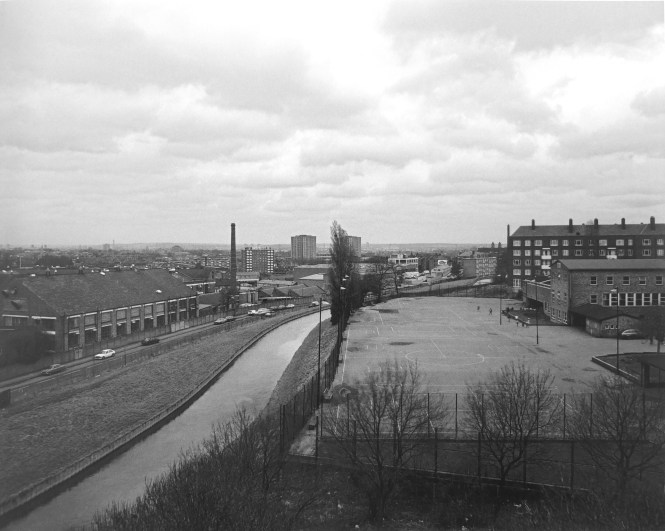
Berris Connolly – Lea Navigation 1987. We see the navigation above the road and factories, bordering a school playground, with inter-war housing blocks behind.
Hackney and the city fringe
Hackney borders the City of London. When Conolly was photographing poverty and neglect, the City was enjoying an office boom. His photograph peers over the boundary towards Liverpool Street Station and the Broadgate development area. At the same time, the development industry commissioned John Davies to photograph the development over Liverpool Street Station – Phase 11 of Broadgate.

Berris Connolly – Worship Street 1987. The building site is for a new signal box. The double arch of Liverpool Street station can be seen, surrounded by cranes building the early stages of Broadgate offices.

John Davies from Phase 11, published by Davenport Associates and The Photographers’ Gallery, 1991
 Reading urban photographs