Looking at photographs of the city – by Yvonne Estop
This blog looks at photographs of urban places and asks ‘What do we we see?’
All photographs are a mixture of visual fact and photographer’s art, but this blog looks closely at the physical subject matter of the pictures: the buildings and spaces, the signs of urban life – what we actually see, what the photographer shows us, and what it says about a place.

Walker Evans, Street and graveyard in Bethlehem, Pennsylvania, 1936
Photography intensifies reality, gives all physical detail equal significance. We are familiar with the idea of reading guidebooks and maps; this is about reading photographs to gain insights about urban places.
Photographs as art and information
Photographs of urban scenes contain information about the location, the activities and the economy of the place. This can help us to understand the place and the nature of urban change.
Photographers make pictures for many reasons but they all combine two characteristics –
- fixing an historic record of the architecture and activity – a factual document of place and event that becomes time-bound, nostalgic or political
- making a personal, artistic interpretation of place as a photograph – many urban photographs are awe-inducing or beautiful. As an aesthetic medium, they turn bits of the tangible world into graphic, dramatic, emotional images, using light, composition and decisive moments. All photographs are surreal – the recognisable becomes strange like a dream.
Whatever the photographer’s intention, the photograph also carries a lot of information – the subject matter – about the actual place. This information can mystify or inform us. We recognise the type of place – a street, an industrial estate, a park and so on. We can read shop names and road signs. But photographs also exclude a lot of information, by removing subject matter from its urban context. When we look at a photograph we infer and assume a lot, and often make an emotional response, often based on what we know and our prejudices.

Gabrielle Basilico, from Interrupted City, 1999
Photographers choose the view very carefully but rarely give any textual explanation or comment about a picture, even when they are engaged with the consequences of city development. This lack of commentary is the case with the most well known ‘fine art’ photographers of the city, including Gabriele Basilico (above, in photographs of Milan) and Thomas Struth. It leaves us to consider why it was taken, what is in the picture, whether it is about that place, or about the broader ‘urban condition’ or about the photographer’s emotional response. John Davies on the other hand does provide that commentary (below).
Photographs of urban places combine prosaic fact and poetic reverie. Prosaically, they are loaded with facts about the use of land, the geographic influences shaping the built environment and the marks of everyday life.
Pictures tell us much more with a modicum of contextualisation. Just a touch of explanation of the economy, planning and transport policy, politics and the property market can transform our understanding of an urban scene.
Whether impressionistic or documentary, photographers often fail to contextualise urban photographs, leaving us admiring their technical skill, but missing the point of what is happening here, what this place represents.
This blog explores what photographs tell us about urban places, the effects of location, economics, planning policy and activity of people – the things that combine to create spirit of place. The blog explores how photographs affect our attitudes to familiar and unfamiliar city places.
Because cities are large and our sense of direction and sense of scale are unreliable, photographs and maps play a role in forming our personal image of the city.
- A map can be read – it shows the layout of a place, how things connect but is not recognisable, not how we experience things
- A photograph can be read – it shows recognisable things and has perspective, like sight, but it is a detached fragment cut out from the whole place.
The prosaic facts take on an intensified reality – we pay much more attention to detail than in normal life.
Our reading of urban photographs is dominated by personal memory and association – how things have changed. This kicks in within about a year after a photograph is taken. Often however, nostalgia can undermine the documentary or artistic intentions of the photographer.
We therefore often miss the basic point that, however old the photograph:
- it is an image of the present: here now (then)… and
- it is always part of a larger urban geography: a location in a space, a neighbourhood, a town, a country, a political regime.
In these blog posts, I read the subject matter of selected photographs and make links with published texts from the same time. I review some exhibitions and books.
- What is the point of picking apart the factual aspects of a picture?
- What is the point of taking a photo of the urban scene if you don’t?
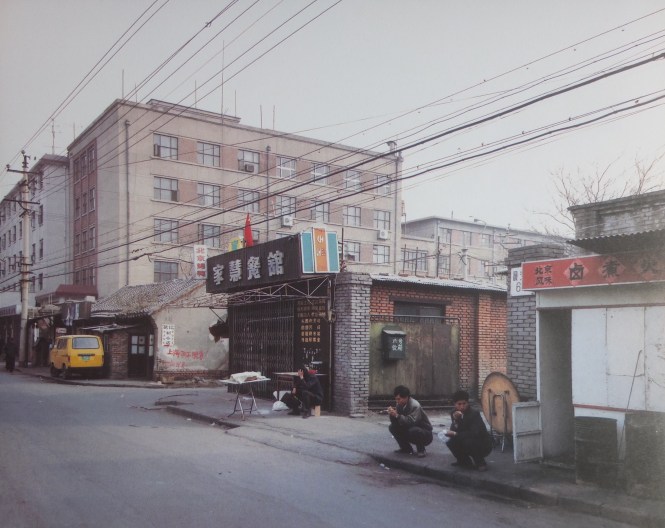
Thomas Struth, NanheyanLu Beijing 1995
Respecting the photographer, enjoying the photograph
The way in which photographs can be read to understand urban places is without prejudice to the photographer’s vision and the qualities of the picture.
Whatever the photographer’s motivation, method and intention, a photograph combines three powers:
- the document: fixing a record;
- the poetic: making a personal interpretation of place as a photograph;
- the formal: the composition of the picture.
Every photograph is partly descriptive – sometimes referred to as topographic, in the manner of a survey: Josef Sudek makes poetic images, but they are still Prague.
The photographer as creator is ever present: Eugene Atget documents Paris, but the pictures exude Atget’s personal vision.
Every photograph has pictorial form: Berenice Abbot records the emergence of modern New York in dramatic graphic composition; Michael Schmidt shows Berlin in incidental, naturalistic form.
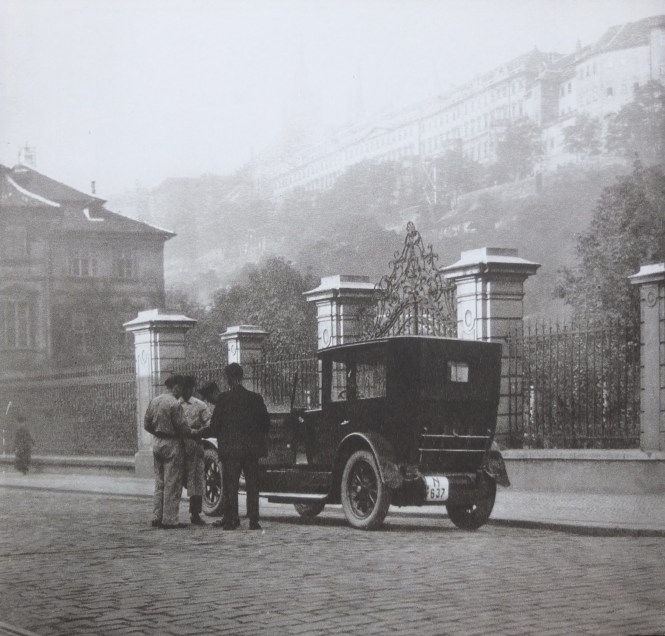
Josef Sudek, 1926

Norio Kobayashi, Landscape 1994
Looking at the urban scene
A town is a vast system, difficult to comprehend. It is in constant flux – slow metamorphosis of building and reorganisation, always showing signs of change – decline and regeneration, which photographs reveal. The precedent for understanding through seeing is Patrick Geddes’ Outlook Tower in Edinburgh’s Old Town. In 1892, the prophetic town planner Geddes used a camera obscura for the general public to observe Edinburgh from above. His intention was to show the interrelated, complex whole of the city and to demonstrate the interaction between ‘place, work and folk’. Geddes stressed the importance of visual observation in understanding places.
Photography is visual observation, and reveals aspects of the urban environment. Large-scale areas, difficult to conceive as a whole can be organised into a rectangular frame for recognition, prompting reassessment, identifying an issue.
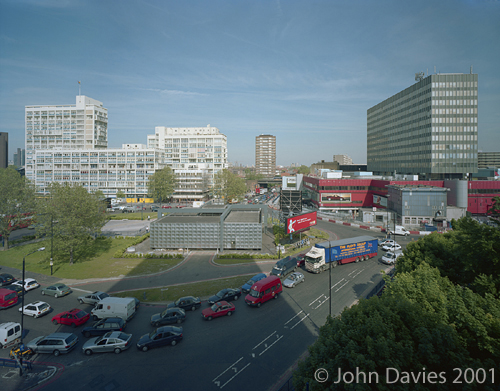
John Davies, Elephant & Castle roundabout
Bits of place
In the long tradition of architectural photography, the building, its client’s brief, architect and construction are the main concerns, and often removed from the urban context. The frame gives a single narrow view, the photograph cuts out the urban continuum.
The photographs of old Paris taken by Eugene Atget are ostensibly a historic record. Some photographs show the buildings facing the public street, some show the backs framing a courtyard, you don’t always know at first glance. Atget photographs gateways and doors – the transition between public and private, outside and inside. Atget shows buildings that reveal use – worn steps, grubby doors, shop windows, sign boards. The photographs can be read as a story of that locality.
A photograph is always a tiny selected fragment of a place, it can represent what it shows. It can represent the bigger whole only by a photographer making a huge and often naive presumption. It gives indicators of place, such as being clearly part of a major city street, but cannot be treated as a microcosm. The problem arises when a photographer or critic claims a photograph is a micrcosm, underestimating the enormity of the whole place.

Garry Winograd, London 1969
Critical urban cliches
Critics of urban landscape look for an aesthetic urban alchemy, and end up repeating common preconceptions of the city: the urban subject matter is often summed up as typical, mundane, tedious, commonplace; or as harsh reality, dispiriting, threatening – clichéd suburban-bred myths of the city.
The critic therefore veers away from the specific facts on display and either makes sweeping generalisations about the city or looks for signs and symbols, state of mind, state of the world, private life and that sometimes leapfrogs the content of the photo.
Film influences public perception of place, and how we read photographs. A film might choose a stately home location and then intensify our perception of grand living. or a film might choose a run-down street to represent urban failure and intensify our prejudices about dereliction.
The failure of photography
The photographic frame, the flattening, the strain to get a lot in, just cannot cope with a large-scale, three dimensional, dynamic urban space. Urban space is unphotographable. We do our best but you have to be in Piazza San Marco, walking in time, to know the space. The dynamics of urbanism struggles with the decisive moment – yet sometimes the magic of place is revealed by the magic of the photograph.
Fact, myth and spirit of place
It is often difficult to place a photograph in its locality; due to framing and selection of view, it lacks locational context. This means that for all its realism, a photograph tends to be impressionistic and indicative of place. Photographs create and intensify urban mythology. All photographs are surreal.
Writers like Patrick Keiller, Will Self, Patrick Wright, Ian Nairn, Jonathan Meades and Iain Sinclair have layered personal, factual, historic, fictional and mischievous associations and created a greater understanding of place as a result. Whether we subscribe to the term psycho-geography or not, photography plays a part in crystallising the spirit of place.
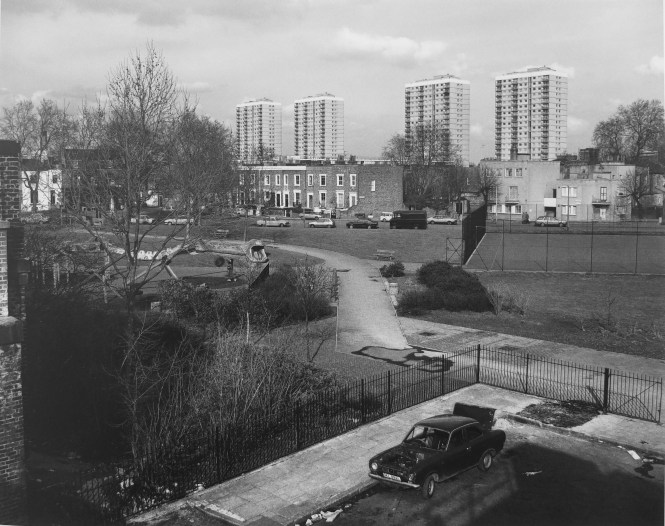
Berris Connolly, Stonebridge Gardens, 1987
Yvonne Estop is an urban designer, town planner and artist. Always fascinated by photographs, photographers and writing about photography.
 Reading urban photographs