
An exhibition in Bologna, northern Italy, about the historic city through photographs. An exhibition about the use of photography to represent urban places and urban change. But reminding us that the images we see are mediated by the photographer, whose picture-making choices affect our perceptions.
It is unusual to see an historic exhibition that does not use photographs as straight factual documents, for showing historic buildings and events. And unusual for the photographers to be discussed – naming them, celebrating the commercial and amateur photographers alike, the institutions commissioning photographs, and acknowledging the anonymous photographers.
This exhibition about the city tells us about the circumstances of the photographers – why they were photographing, the context of their work – journalism, polemic, politics, art, curiosity, income generation. The way that changing camera technology changed the kind of photographic representation is elucidated. The way that politics and war influenced public images. These circumstances affect our perceptions of the city.
For example, the street photographers between the 1930s and 1960s who sold candid pictures of passers by; amateurs who followed their own interests, one notably photographed all the city gates and walls before demolition in the 1800s; the society photographers who photographed politicians and celebrities who shaped the economy and influenced its culture; the official photographs of construction.
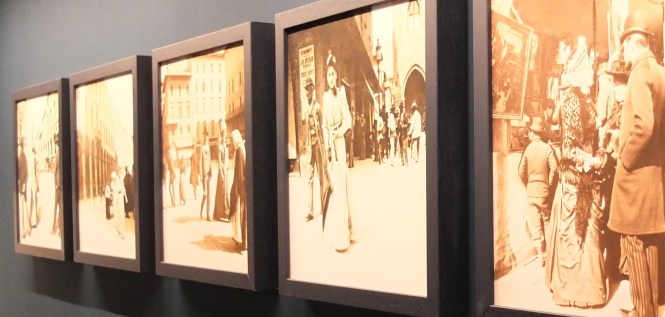
People photographed by street photographer Ofindo Guerrini (attr) 1893
The exhibition poster is of a photographer, in a crumpled suit, standing on the rim of a fountain in front of a statue, with an unweildy box camera. The introductory text says:
….He is a photographer. A medium format camera hangs from his neck. It may be a Graflex, or a clone of one. He is standing on the fountains edge, surveying his surroundings… For once, the date of the photograph doesn’t much matter…. Instead, let us consider this image as an icon. The icon of the gaze we normally do not see, as it is the one that makes us see. The gaze of the photographer, that invisible witness who usually tries to make their presence be forgotten, who says “look over there”….
Before entering into contact with your eyes, the images of Bologna that you will see, ….have passed through the eyes of such photographers.
Perhaps we ought to equip ourselves with a little cautiousness with the realisation that our tendency to recognise ourselves in those urban spaces, places and scenarios that we know and love can also be a trap. We dive straight into photographs as though they are open windows onto our own memories, without even considering the fact that someone else decided what we were and were not meant to see, as well as how we were meant to see it.
That decision-making process is almost never simply the work of one individual: photographers’ work is often commissioned by institutions or organisations; but even when it is the fruit of the passion of the amateur photographer, it always has a purpose and a destination. The Bologna that we see in these photographs is not Bologna as it was, but rather Bologna as someone wanted it to be seen, by both contemporary and future audiences. It is a premeditated Bologna.
And yet even those intentional, political or artistic decisions of representation, once we are aware of them, photography itself allows us to dismiss, on the appearance of places as they were and how they have changed.
The exhibition concludes:
….some photograhers now find pride in promoting themselves as authors and become urban explorers. Excitedly, they discover a never-before represented city: not an extraordinary Bologna, but an infra-ordinary one – sometimes anecdotal, sometimes picturesque or sentimental, but where nothing is yet known or taken for granted. A city of people.
And a short walk from the gallery to the public library, there is the outstanding Urban Centre Bologna, promoting an understanding of the present and future city. Containing huge models of the city, explanations of all the current and planned development and transport projects, spaces for consultation meetings and an audio-visual presentation explaining planning policy.


 Reading urban photographs